Farewell to “Pseudo-Intelligence,” Return to “True Safety”: 2026 Cross-Border Pet Nail Clipper Market Reaches Inflection Point with Dark Nail Transparency and Ultra-Quiet Technology
The Myth of the LED: Why Visibility Was Never Really Solved
Five years ago, adding an LED to a nail clipper felt like a breakthrough. Finally, pet owners could see something before they cut. Amazon listings exploded with claims of “safety light technology” and “no more blind trimming.” The logic seemed sound: more light equals more visibility equals fewer accidents.
Except it never worked that way.
The uncomfortable truth, long buried under five-star reviews for products that never faced the real test, is that standard LED illumination does almost nothing for dark nails. White nails? Yes. Clear or light-colored nails? Absolutely. But the moment you point that little bulb at a black nail—the kind sported by countless Labradors, Poodles, Schnauzers, and mixed breeds—the light hits an optical wall. The quick stays hidden. The owner stays anxious. And the “safety feature” becomes nothing more than theatrical lighting for a procedure that remains just as risky as it ever was.
Consumer data from 2026 tells the story. Reviews on major platforms like Amazon and Chewy are increasingly blunt: “The LED is useless on my dog’s black nails.” “I still can’t see anything.” “Why call this a safety clipper when I’m still guessing?”
The market has listened. The inflection point of 2026 is defined by one simple but elusive goal: making the invisible visible. Not with brighter bulbs. Not with more LEDs. With technology that actually sees through darkness.
Breaking the Optical Barrier: The Science of Seeing Black
The breakthrough products of 2026 have abandoned the assumption that more light is the answer. They’ve embraced a different principle: the right light.
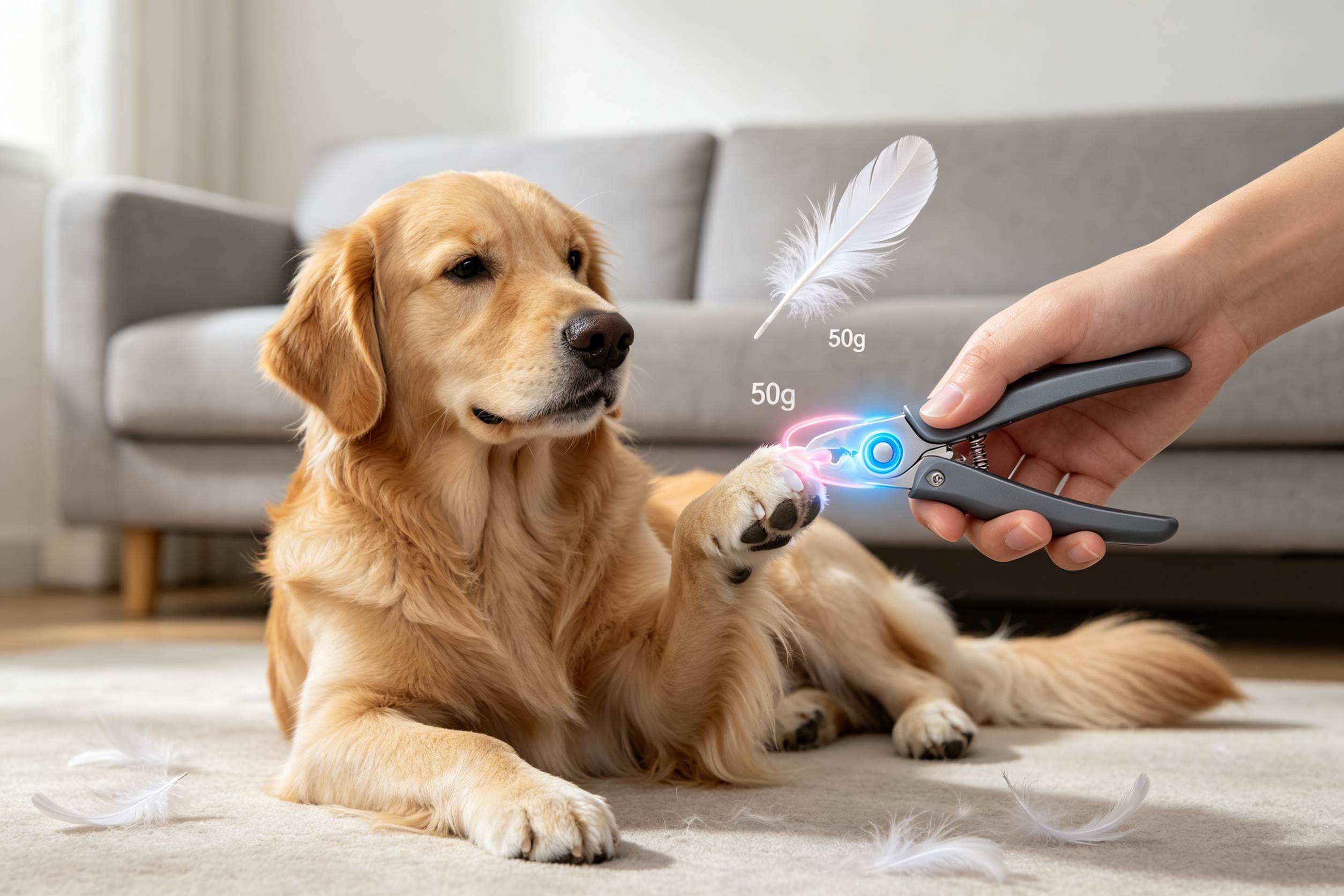
Standard LEDs emit a broad spectrum that reflects off the surface of the nail but fails to penetrate dark pigmentation. The new generation of “dark nail transparency” tools employs multi-spectral illumination—combining visible light with specific near-infrared wavelengths that pass through melanin-rich keratin and reveal the blood-filled quick beneath.
This isn’t a marketing tweak. It’s a fundamental rethinking of how optical tools should work for pets. Infrared light, invisible to the human eye, behaves differently than white light. It scatters less. It penetrates deeper. When combined with high-definition optical sensors and real-time image processing, it creates something no LED clipper has ever delivered: a clear, actionable view of the quick inside a black nail.
Some early-adopter products are already pushing further. By integrating low-power AI chips, they can analyze the nail image, highlight the quick’s location, and even provide audible or haptic feedback when the user approaches the safety boundary. This isn’t artificial intelligence for its own sake. It’s intelligence applied to a single, critical task: preventing pain.
The result is the first true solution to a problem that has haunted pet owners for generations. Black nails are no longer a source of dread. They’re just nails.
Silence as Safety: Why Noise Matters More Than Speed
Visibility solves half the equation. The other half is cooperation.
Anyone who has tried to trim a resistant cat’s claws or grind a nervous dog’s nails knows the drill: the moment the grinder spins up, the animal panics. Ears flatten. Bodies twist. Legs pull away. Sometimes the fight is so violent that continuing is impossible. Sometimes the owner gives up entirely, leaving nails to grow until they curl or crack.
The culprit is obvious but historically ignored: noise.
Dogs hear frequencies up to 65,000 Hz. Cats go even higher, reaching 85,000 Hz. A standard electric nail grinder, with its cheap motor and unbalanced rotor, emits a piercing whine that sits right in the middle of their most sensitive hearing range. To a cat, it may sound like an alarm. To a dog, a threat. To both, a reason to flee.
The 2026 turning point treats noise not as an unavoidable byproduct but as a design flaw to be eliminated. The new benchmark is 40 decibels—roughly the sound of a quiet library or soft rainfall. Achieving this requires precision engineering that was once considered too expensive for mass-market pet tools.
Brushless DC motors replace the noisy, sparking motors of the past. Rotors are dynamically balanced to eliminate vibration. Housings are layered with sound-dampening materials. Bearings are precision-ground. The result is a device that, when held near a pet’s ear, produces nothing more than a gentle hum.
But silence alone isn’t enough. Heat matters too.
Traditional grinders, running at high speeds with poor heat dissipation, can quickly reach temperatures that cause discomfort or even minor burns. A pet that feels heat on its nail will associate the grinder with pain forever. The new generation of ultra-quiet tools integrates thermal management—smart speed regulation that prevents overheating, plus advanced coatings that wick heat away from the nail surface.
When a pet experiences a grinder that doesn’t scream and doesn’t burn, something remarkable happens. Resistance fades. Tolerance grows. Over time, what was once a battle becomes routine. That’s not convenience. That’s trust.
The End of Feature Stacking: Why Less Is Now More
For the past decade, the pet product industry has been trapped in a feature arms race. More modes. More attachments. More lights. More buttons. The assumption was simple: more features equal more value.
But features are not value. Features are potential. Value is what happens when potential meets reality.
The 2026 inflection point marks a clear rejection of feature stacking in favor of feature focus. Consumers no longer want a clipper that also tracks their dog’s activity, plays music, or connects to an app they’ll never open. They want a clipper that does one thing perfectly: trim nails safely, without stress.
This shift mirrors broader trends in consumer behavior across categories. From smartphones to kitchen appliances, buyers are increasingly skeptical of products that promise everything and deliver little. They’ve learned that a tool with fifty functions often does none of them well. They’ve learned that simplicity, when backed by genuine engineering, is the ultimate luxury.
In the pet nail clipper category, that means products defined by two capabilities and two alone:
The ability to see the quick in any nail, regardless of color.
The ability to trim or grind without triggering fear.
Everything else is noise—literally and figuratively.
What This Means for the Global Market
The implications for cross-border sellers and manufacturers are profound.
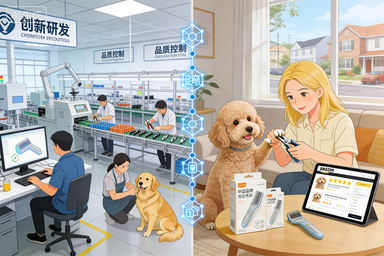
For years, the barrier to entry in this category was low. Generic factories churned out identical clippers by the millions. Sellers competed on price, packaging, and listing optimization. The product itself was interchangeable. Differentiation was a myth.
That era is ending.
The 2026 turning point introduces genuine technological differentiation. Dark nail transparency requires optical engineering, multi-spectral light sources, and sometimes embedded processing. Ultra-quiet operation requires precision motor design, advanced materials, and rigorous acoustic testing. These aren’t capabilities that can be copied overnight or sourced from the cheapest supplier.
For brands that invest, the reward is a defensible moat. A product that actually solves the two hardest problems in pet nail care can’t be easily replicated. It commands higher prices. It earns genuine reviews. It builds loyalty that no amount of advertising can buy.
For brands that don’t, the path forward is narrowing. Competing on price alone in a market where consumers have tasted real innovation is a losing game. The bottom of the Amazon search results is crowded and getting more crowded every day. The only way up is through.
The Deeper Current: Why This Matters Beyond Commerce
There’s a reason this inflection point resonates so deeply with pet owners. It’s not just about nails. It’s about the relationship those nails are attached to.
Pets are no longer animals that happen to live in our homes. They’re family. In survey after survey, owners describe their dogs and cats as children, companions, sources of unconditional love. The idea of hurting them—even accidentally—is unbearable.
That’s why the old way of trimming, the way that relied on guesswork and luck and holding your breath, was never really acceptable. It was just the only option.
Now it’s not.
When a product lets an owner see clearly into a black nail, it doesn’t just prevent bleeding. It prevents the moment of panic when the dog yelps and the owner realizes what they’ve done. It prevents the guilt that follows. It prevents the erosion of trust that makes future grooming harder and harder.
When a product grinds so quietly that a cat dozes through it, it doesn’t just save time. It proves that grooming doesn’t have to be a fight. It opens the door to a relationship where care is accepted, not endured.
This is the deeper truth behind the 2026 turning point. The technology matters because the bond matters. Innovation matters because love matters. And safety matters because nothing else is acceptable when the one you’re caring for can’t speak, can’t explain what hurts, can only trust you to get it right.
Looking Forward: The Shape of Things to Come
What comes next?
If the 2026 inflection point teaches anything, it’s that the future belongs to those who solve real problems with real engineering. The days of slapping LEDs on existing designs and calling it innovation are over. The days of competing on spec sheets filled with irrelevant numbers are numbered.
The next wave of pet care products will be defined by:
Deep specialization. Not tools that do everything, but tools that do one thing so well they become indispensable.
Genuine sensing. Not cameras that show the nail, but sensors that see through it. Not microphones that record sound, but designs that eliminate it.
Animal-centered design. Not products built for human convenience and adapted for pets, but products built from the ground up around how animals actually perceive the world.
For pet nail clippers, that means continuing to push the boundaries of both transparency and silence. Multi-spectral imaging will become more refined, more affordable, more widely available. Quiet motors will become quieter still, approaching the threshold of inaudibility. Materials will improve. Ergonomics will evolve.
But the core principle will remain: technology should disappear into the background, leaving only safety, trust, and the quiet confidence of a job done right.
Conclusion: The End of the Beginning
The 2026 cross-border pet nail clipper market stands at a crossroads. Behind lies a decade of pseudo-intelligence—products that promised much and delivered little, features that looked good on boxes but failed in real homes. Ahead lies something better: genuine innovation aimed at genuine needs, safety that actually protects, quiet that actually calms.
The brands that cross successfully will share one characteristic: they listened. Not to trends, not to competitors, not to the loudest voices in the room. They listened to the owners who struggled with black nails and anxious dogs. They listened to the cats who flinched at the sound of grinders. They listened to the quiet but urgent demand for tools that honor the relationship between human and animal.
That demand has always been there. Now, finally, technology is catching up.
The inflection point of 2026 is not the end of the story. It’s the end of the beginning. The real work—the work of building tools worthy of the trust pets place in us—has just started.
And for the first time, we have the tools to do it right.