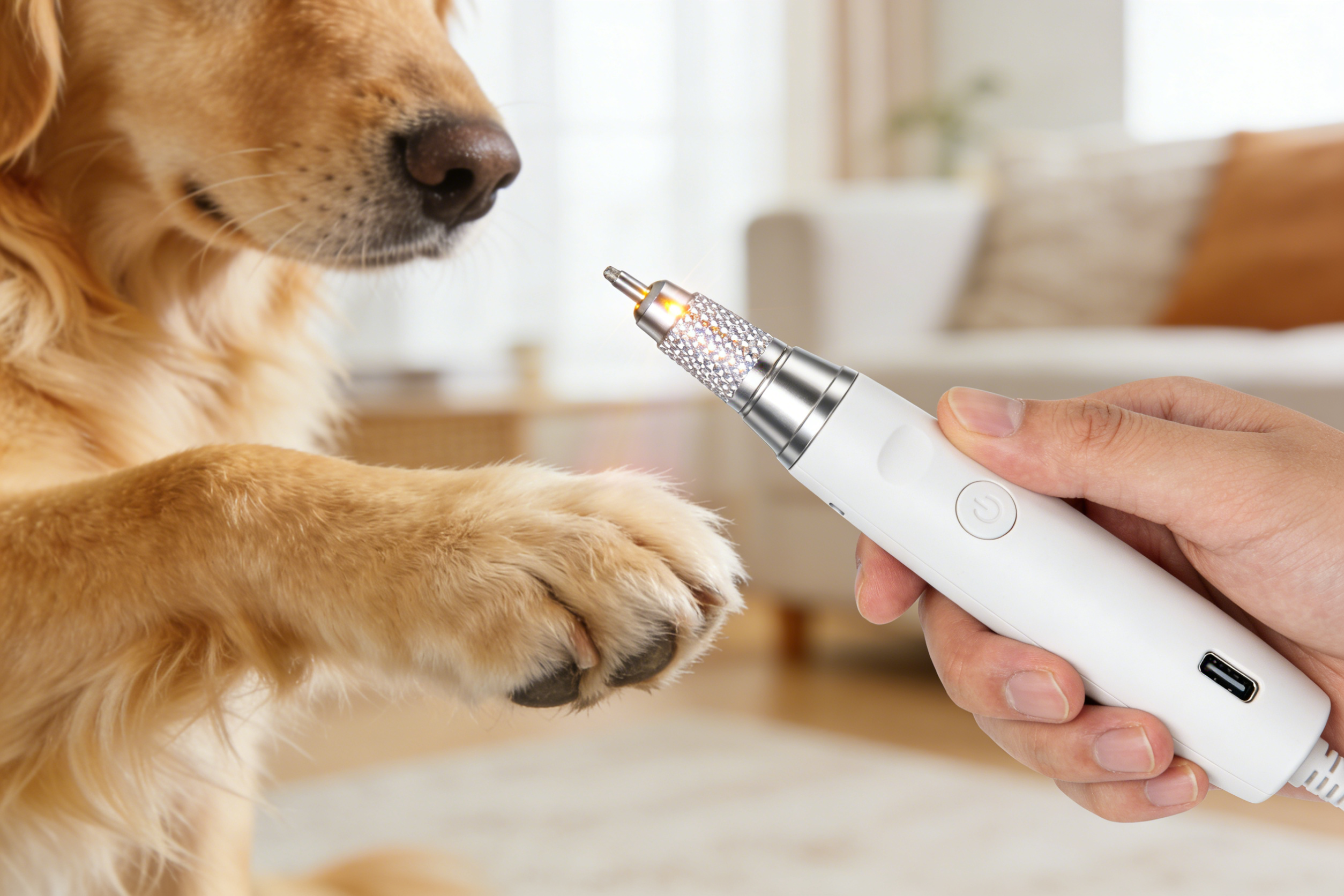
The 2026 Pet Nail Trimmer Revolution: Why "Boring" Is the New Billion-Dollar Bet
The Dirty Secret of the Pet Aisle
Walk into any pet store. You will see thirty brands of dog food, twenty types of leashes, and fifty squeaky toys shaped like tacos. But the nail care section? Three products. All broken. All gathering dust.
Why? Because nobody has solved the actual problem.
The actual problem is not trimming the nail. The actual problem is the dog. Specifically, a dog's nervous system.
Standard guillotine clippers create a crushing shear force. That "snip" sound? To a dog's ear, it registers at 110 decibels—equivalent to a smoke alarm. Standard rotary grinders create high-frequency vibration that travels up the nail bed into the bone. Dogs don't "hate" nail trims. They experience them as acoustic and vibrational trauma.
This is not pet psychology. This is biophysics.
And for twenty years, the pet industry ignored it. They sold the same clippers. They sold the same loud grinders. And they accepted 20-30% return rates as "normal."
The 2026 Inflection Point
The January 2026 report confirms what early engineering teams discovered in late 2024: you can fix the physics.
Three breakthroughs converged in the past eighteen months:
Breakthrough #1: The Brushless DC Motor
Standard grinders use cheap motors that spin at 15,000 RPM but vibrate like a jackhammer. New brushless motors—originally designed for drones—spin at 8,000 RPM with 90% less vibration. The nail still grinds. The bone feels nothing. The dog stops flinching.
Breakthrough #2: Helical Grinding Drums
Traditional sandpaper drums create a "chattering" effect—micro-bounces that transfer shock up the nail. Helical drums, cut at a 15-degree angle, create continuous shearing. It is the difference between driving on a cobblestone road versus fresh asphalt. Same speed. Zero chatter.
Breakthrough #3: The 40dB Floor
Acoustic engineering now allows motors to operate under 40 decibels at six inches. For context: 40dB is quieter than rainfall. A sleeping cat will not wake up. A nervous rescue dog will not panic. This is not a "feature." This is a category reset.
Why Sellers Are Running Toward This
Here is the perspective that changes everything.
Most American and European pet brands are slow. They design one product every two years. They test in focus groups. They launch with a massive advertising budget and hope for the best.
Sellers operating out of high-velocity manufacturing regions do things differently. They iterate every 45 days. They watch return rate data in real time. And in 2025, they noticed something strange:
Standard grinder return rate: 22% (reason: "dog hates it")
Quiet grinder return rate: 6% (reason: "battery life could be better")
That 16-point spread is not a statistic. It is a profit waterfall.
Lower returns = lower storage fees from return processing
Lower returns = higher seller ratings = lower advertising costs
Lower returns = fewer negative reviews = higher conversion rates
The 5.5% CAGR is not growth. It is redistribution. Market share is draining out of loud, cheap grinders and flowing into quiet, premium ones. The total market size is expanding slowly. But the winners' market share is expanding exponentially.
The "Smart Comb" Side Bet (And Why It Works)
The same January 2026 report calls out smart de-shedding combs as the second hot segment. At first glance, this makes no sense. A comb is a comb. How do you make it "smart"?
Here is the insight that most analysts missed: Smart combs are not for pets. They are for vacuum cleaners.
Think about it. The number one complaint about de-shedding is not that the brush fails. It is that the hair goes everywhere. Floating hair sticks to clothes, carpets, and air filters. Pet owners spend more time cleaning up after brushing than actually brushing.
The smart comb solves this with a simple mechanical hack: integrated static generation. A small piezo element creates a low-level electrostatic charge on the comb's teeth. Loose hair sticks to the comb instead of flying away. One button press discharges the hair into a trash bin. Zero floaters.
Is this "smart" in the artificial intelligence sense? No. Does the customer care? Also no. They care that their black pants no longer look like a shedding Husky. The word "smart" is marketing. The static charge is physics. And the 5.5% CAGR is the result.
The 2026 Playbook
If you are a seller reading this, here is the strategy that does not exist anywhere else right now:
Do not sell one product. Sell a "grooming session."
The pet owner does not want a grinder. They do not want a comb. They want a 10-minute, no-struggle, no-mess grooming routine. Your job is to assemble that routine from components and sell it as a system.
The Entry Bundle:
Silent nail grinder (under 40dB, helical drum, 8,000 RPM brushless)
Static-charge de-shedding comb (basic version, no battery, passive static)
Dust collection attachment (fits any vacuum hose)
The Premium Bundle:
Everything above, plus:
LED safety light on grinder (illuminates the "quick" inside the nail)
Rotating pin comb (for dogs with thick undercoats)
Storage case with built-in USB hub
The Subscription Add-On:
Replacement grinding drums every 90 days
Replacement static brushes
Access to video grooming guides
The Geographic Nuance
The 5.5% CAGR applies globally, but the type of buyer varies wildly:
United States: Buy quietness. The American pet owner is anxious. They watch their dog's face during grooming. If the dog flinches, they stop. If the grinder is silent, they use it weekly. Sell emotional peace.
Germany and Northern Europe: Buy durability. These customers will read your 45-page manual. They will test the RPM with a tachometer. They will keep the product for seven years. Sell engineering specifications and replaceable parts.
Japan and South Korea: Buy compactness. Apartments are small. Storage is precious. A grinder that fits in a drawer and charges via USB-C is worth twice a larger unit with more power. Sell minimalism.
Brazil and Mexico: Buy price-to-performance. Disposable income is lower, but pet ownership is high. They want one device that does everything. Sell three-in-one functionality at an accessible price point.
The One Warning
The 5.5% CAGR comes with a trap: certification costs.
Quiet motors require better bearings. Better bearings require tighter tolerances. Tighter tolerances require better quality control. Better quality control costs money.
In 2026, the gap between "cheap grinder" and "good grinder" is no longer features. It is safety and compliance certifications. The manufacturers that skip certifications to save a few dollars per unit will be banned from major marketplaces by late 2026. The manufacturers that pay for certifications will own the category.
If you are sourcing from global wholesale platforms, do not ask for the lowest price. Ask for the certification folder. If the supplier hesitates, walk away. The 5.5% growth is real, but it belongs to compliant sellers only.
The Bottom Line
The pet nail trimmer will never be exciting. It will never go viral on social media. It will never win design awards.
But it will be bought by 78 million American households, 35 million European households, and 120 million Asian households—every single month, for the next decade.
The January 2026 report put a number on it: 5.5% CAGR.
That number is not a prediction. It is a confirmation. The market has already decided. The only question left is which sellers will claim their share.
Will you be one of them?