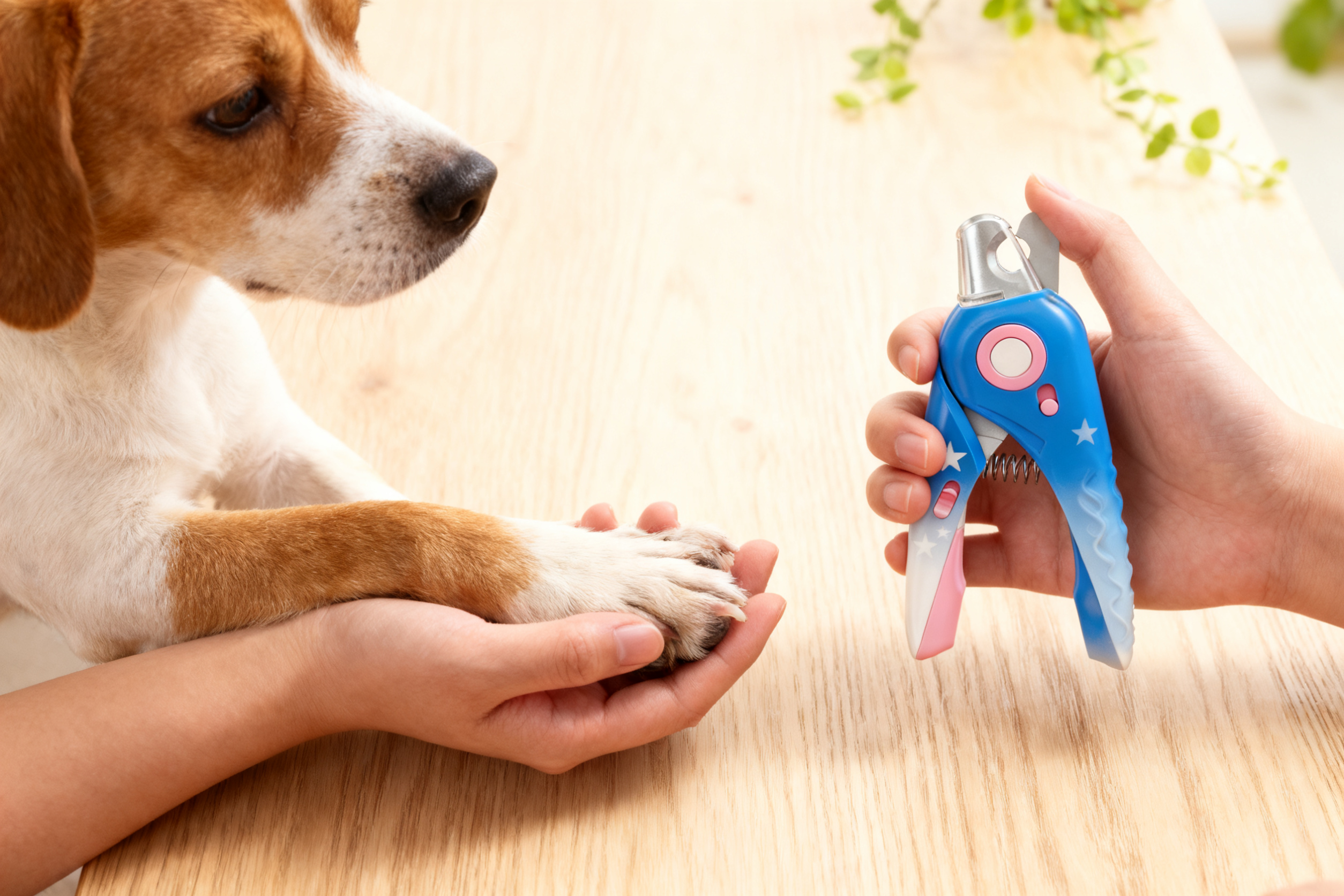
The Nail Clipper That Keeps Coming Back: Why I Stopped Chasing Viral Hits and Started Selling "Boring" Things
What Nobody Tells You About "High Frequency"
We hear that phrase all the time in e-commerce: "sell high-frequency items." It sounds smart. It sounds strategic. But nobody ever slows down to explain what it actually means in practice, especially for a small seller with limited capital.
Let me break it down the way I wish someone had broken it down for me.
A high-frequency item is not just something people buy often. It's something people need to buy again, whether they want to or not.
Coffee pods are high-frequency. Diapers are high-frequency. Pet food is high-frequency. These are products tied to biological rhythms. They're unavoidable.
Pet nail clippers sit in that same corner. A dog's nails grow approximately 1/8 of an inch per week. A cat's nails grow slightly slower but shed in layers. Unless the pet lives on concrete and walks ten miles a day, those nails need attention every 3-4 weeks. That is not a lifestyle choice. That is physiology.
So when I sell a nail clipper, I'm not selling a gadget. I'm selling a recurring appointment. The customer doesn't buy it and forget about it. They use it, they remember the experience, and when the blade dulls or they lose it (which happens more often than you'd think), they need another one.
This is where the math starts to get interesting.
If a customer buys one nail clipper from me and never returns, that's one transaction. But if I can get them to buy again in six months, I've doubled the lifetime value without doubling my acquisition cost. If they buy a third time a year later, I've tripled it. The customer acquisition cost stays the same. The marketing effort stays the same. The only thing that changes is that I'm selling to someone who already knows me, already trusts me, and doesn't need a discount to make a decision.
That is the quiet power of high frequency.
The Return Rate Lie That Everyone Believes
Here's something that still shocks me when I talk to other sellers.
Everyone obsesses over conversion rates. Everyone obsesses over click-through rates. But almost nobody obsesses over return rates, which is insane, because a return destroys your profit margin on a lightweight item faster than anything else.
Let me walk you through the math of a $10 nail clipper.
Your landed cost (product + shipping from factory to your warehouse) is $2.50. Your Amazon or Shopify fees take another $2.00. Your shipping to the customer costs $3.50. Your advertising cost is $1.00 per order. You're left with $1.00 of gross profit per unit. It's thin, but it's real.
Now the customer returns it.
You refund the $10. You eat the $3.50 shipping cost you already paid. You pay return shipping of another $3.00. Your platform keeps the $2.00 fee (they don't refund that in most cases). You're now negative $8.50 on that transaction. To recover that loss, you need to sell nine more units of the same product at full profit margin. Nine units. Just to break even on that one return.
That's why return rate is everything. It's not a customer service metric. It's a survival metric.
Now think about nail clippers versus other pet products.
A bed gets returned because it's the wrong size.
A harness gets returned because it doesn't fit the dog's chest.
A toy gets returned because the dog destroyed it in thirty seconds.
A nail clipper gets returned because... well, almost never.
Why? Because the dimensions are standard. The function is universal. As long as the blade cuts and the handle doesn't snap, the product does exactly what it promises. There's no ambiguity. There's no "it didn't work for my cat" because a nail is a nail. There's no "it was too small" because it's held in your hand, not worn on the body.
The only scenario that triggers a return is if the customer accidentally cuts the quick and blames the tool. And that's preventable. A simple safety guard—a piece of plastic that limits how deep the blade can go—eliminates 90% of that risk.
When you sell a nail clipper, you are selling a product that almost never comes back. And in this business, that is gold.
The Stress Factor That Works in Your Favor
Here's an angle I haven't heard anyone talk about, and it's the one that changed everything for me.
Buying a nail clipper is stressful for the customer.
Not in a bad way. In a way that works in your favor.
A first-time pet owner is terrified of hurting their animal. They've read the horror stories. They've seen the videos of dogs yelping and bleeding. They approach the purchase with anxiety. They read reviews obsessively. They look for the word "safe" more than they look for the word "sharp."
That anxiety means they are paying attention. They are not impulse-buying a nail clipper the way they impulse-buy a colorful collar. They are making a considered, careful decision.
And here's the beautiful part: when they buy from you and it goes well—when the clipper is easy to hold, when the guard prevents over-cutting, when they finish the job without drama—you have just given them relief. Not satisfaction. Relief. That's a stronger emotion.
They remember you. Not because you were flashy. Not because you had a clever slogan. But because you made a stressful moment manageable.
That memory drives repurchase. And it drives recommendation. When their friend gets a new puppy and asks, "What clipper should I buy?", they don't say, "Check out this cool brand." They say, "Get the one I use. It's safe."
That word-of-mouth is free. And it's powerful.
The Invisible Upgrade Path
Most sellers treat nail clippers as a single product. Buy once, done. That's leaving money on the table.
Here's what I discovered by accident.
After selling clippers for about eight months, I noticed a pattern in the questions customers asked. Some would write to me and say, "My dog is really anxious. Is there a quieter option?" Others would say, "I have arthritis in my hands. Is there something with a bigger grip?" A few would say, "I travel a lot. Do you have a compact version?"
These weren't complaints. They were upgrade requests disguised as questions.
So I built a simple ladder.
I kept the basic clipper as my entry point. Low price. Simple features. Great for beginners.
Then I added a mid-tier version with an LED light at the tip. Because when you're cutting dark nails, visibility is everything. You can see the quick inside the nail. It reduces the fear of cutting too deep. That's not a gimmick. That's a genuine improvement.
Then I added a premium version with replaceable blades and a rubberized grip. The blade replacement means the clipper lasts for years. The grip helps people with weaker hands. The packaging is nicer. The price is three times higher.
The same customer who bought the basic version six months ago is now ready for the mid-tier. They've gained confidence. They trust the brand. They're willing to pay more for a better experience. And the premium version becomes an aspirational purchase—something they buy for themselves as a "treat" or give as a gift to a fellow pet owner.
This is the invisible upgrade path. Nobody talks about it because it's not flashy. But it doubles your average order value over time without any extra advertising spend.
Why Shipping Costs Don't Eat Your Margin
One of the silent killers in cross-border e-commerce is shipping.
If you sell a heavy or bulky item, your shipping cost eats your margin alive. If you sell a fragile item, your packaging cost eats it alive. If you sell a seasonal item, your storage cost eats it alive.
Nail clippers are none of those things.
They weigh almost nothing. A standard clipper with packaging weighs maybe 50 grams. That keeps your shipping cost at the lowest tier for any carrier. You can ship them internationally without cringing at the label.
They don't break in transit. There's no glass. No liquid. No complex electronics. You can throw them in a padded envelope and they arrive perfectly functional. That means no packaging upselling, no special handling fees, no insurance premiums.
They don't expire. They don't go out of style. They don't get discontinued because next year's model is different. The basic design of a nail clipper hasn't changed significantly in decades, and it won't change significantly in the next decade. You can hold inventory without panicking about obsolescence.
When you combine these factors—light weight, durability, non-seasonality—you get a product that lets you compete on price without squeezing your margins to death. You can afford to be reasonable. You can afford to build a reputation for fair value.
The Unsexy Strategy That Actually Works
Let me give you the playbook I've been using. It's not exciting. It's not going to get you featured in a case study. But it's working.
Step one: make the first purchase safe.
Include a simple instruction card. Show a diagram of where the quick is. Show how the safety guard works. Make the customer feel like they can't make a mistake. This alone cuts your return rate to near zero.
Step two: capture the customer.
I put a small slip in the box with a QR code. It leads to a short video of me (or my cat) demonstrating the clipper. At the end, I invite them to join a mailing list where I send grooming tips once a month. No hard sell. Just utility. That list is now my most valuable asset.
Step three: time the follow-up.
After four months, I send an email: "Your clipper has been working hard. If you notice any dulling, here's a 15% discount on a replacement." This acknowledges the product's lifespan without making it sound defective. It's honest. It's respectful. And it converts.
Step four: offer the upgrade.
At the six-month mark, I send another email. This one shows the mid-tier clipper with the LED light. "You've been trimming for six months. Here's a tool that makes it even easier." The conversion rate on this email is higher than any cold ad I've ever run.
That's it. Four steps. No magic. No hacking. Just common sense.
What I Want You to Take Away
I'm not writing this to convince you that nail clippers are the only product you should sell. That would be foolish.
But I am writing this because I see too many small sellers burning money on trend-chasing products that look exciting and deliver disappointment. They're fighting for attention in crowded markets. They're dealing with picky customers who return everything. They're constantly anxious about the next algorithm change or shipping price hike.
Nail clippers don't solve all those problems. But they solve enough of them.
They give you a stable base. A recurring revenue stream. A low-stress customer experience. A product that doesn't fight you.
When you have that stability, you have room to experiment with other products. You can take risks on flashy items without risking your entire business. You can invest in better photography, better packaging, better customer service, because you know the nail clipper sales will cover your fixed costs.
That's what people mean when they talk about "boring" products. They don't mean dull. They mean dependable. They mean you can sleep at night knowing your inventory won't rot in a warehouse.
I still sell other things. But my nail clippers are my anchor. They're the reason I can afford to be creative elsewhere.
And if that's not a good reason to give them a second look, I don't know what is.