Pet Nail Clippers: Why This Unassuming Tool Remains the Most Reliable “Cash Cow” in Pet Grooming
A Market Hiding in Plain Sight
While headline figures often emphasize the broader grooming tools market, the pet nail clipper segment itself is far from trivial. Estimates place the global pet nail clipper market at roughly US$86 million in 2025, with projections reaching US$162 million by 2034—a CAGR of 7.27%, notably outpacing the broader grooming tools category. The broader pet nail trimmer category, which includes electric grinders and manual clippers, commands an even larger value pool that industry analysts track as a distinct commercial segment.
What makes this category compelling is not simply its growth rate. It is the structural characteristics of the product that create durable, repeatable economics.
The Anatomy of a Cash Cow
Pet nail clippers exhibit the hallmarks of a classic “cash cow” product category in the Boston Consulting Group sense: high relative market share potential, low investment requirements for maintenance, and stable, predictable demand. Several factors converge to produce this profile.
First, nail trimming is a non-discretionary grooming task. Unlike styling products or premium shampoos, nail clippers address a genuine animal welfare need. Overgrown nails cause discomfort, affect posture, and can lead to health issues. The demand is not driven by fashion or trends; it is driven by the biological reality of pet ownership.
Second, the purchase decision is remarkably frictionless. A pet owner does not spend weeks researching which nail clipper to buy. The functional requirements are simple and universally understood: it must be sharp, safe, and easy to hold. This low decision threshold means that clippers convert browsers into buyers efficiently—a critical attribute for e-commerce sellers navigating expensive advertising environments. The safety guard feature on models like the gonicc clippers, which has accumulated over 80,000 Amazon ratings, demonstrates how a single well-executed feature can become the default choice for millions of anxious first-time trimmers.
Third, nail clippers exhibit favorable repeat purchase dynamics. While they are not consumed at the rate of shampoo or treats, they are frequently lost, misplaced, or dulled. More importantly, they serve as gateway products. A pet owner who successfully trims their dog‘s nails at home for the first time often returns to purchase additional grooming tools—brushes, trimmers, grooming kits. The nail clipper becomes the entry point into a broader relationship.
Demand Drivers: The Humanization Effect
The underlying engine of this category is the accelerating humanization of pets. As animals become unambiguously regarded as family members, owners increasingly prioritize their comfort, hygiene, and appearance. This shift has profound implications for grooming behavior.
The DIY home grooming trend, accelerated by the pandemic and sustained by economic pressures, has transformed what was once a professional service into a routine household activity. Pet owners who previously paid $60 or more per professional grooming visit now trim nails at home to reduce long-term expenses and improve convenience. The savings are immediate and tangible, which reinforces the behavior. A $10 clipper that lasts for years represents an obvious value proposition compared to repeated professional appointments.
E-commerce platforms and social media have amplified this trend by reducing the knowledge barrier. Video tutorials on nail trimming techniques are abundant and accessible. Influencer content and online reviews build confidence among first-time trimmers. The result is a growing population of pet owners who are willing to attempt home grooming but need the right tool to do so. The pet nail clipper is that tool.
The Innovation Frontier: Where Value Is Created
Despite the product’s apparent simplicity, meaningful innovation continues to reshape the competitive landscape. The defining challenge in nail trimming is the anxiety of cutting the quick—the sensitive, blood-rich tissue inside the nail. This fear is the single greatest barrier to home trimming adoption.
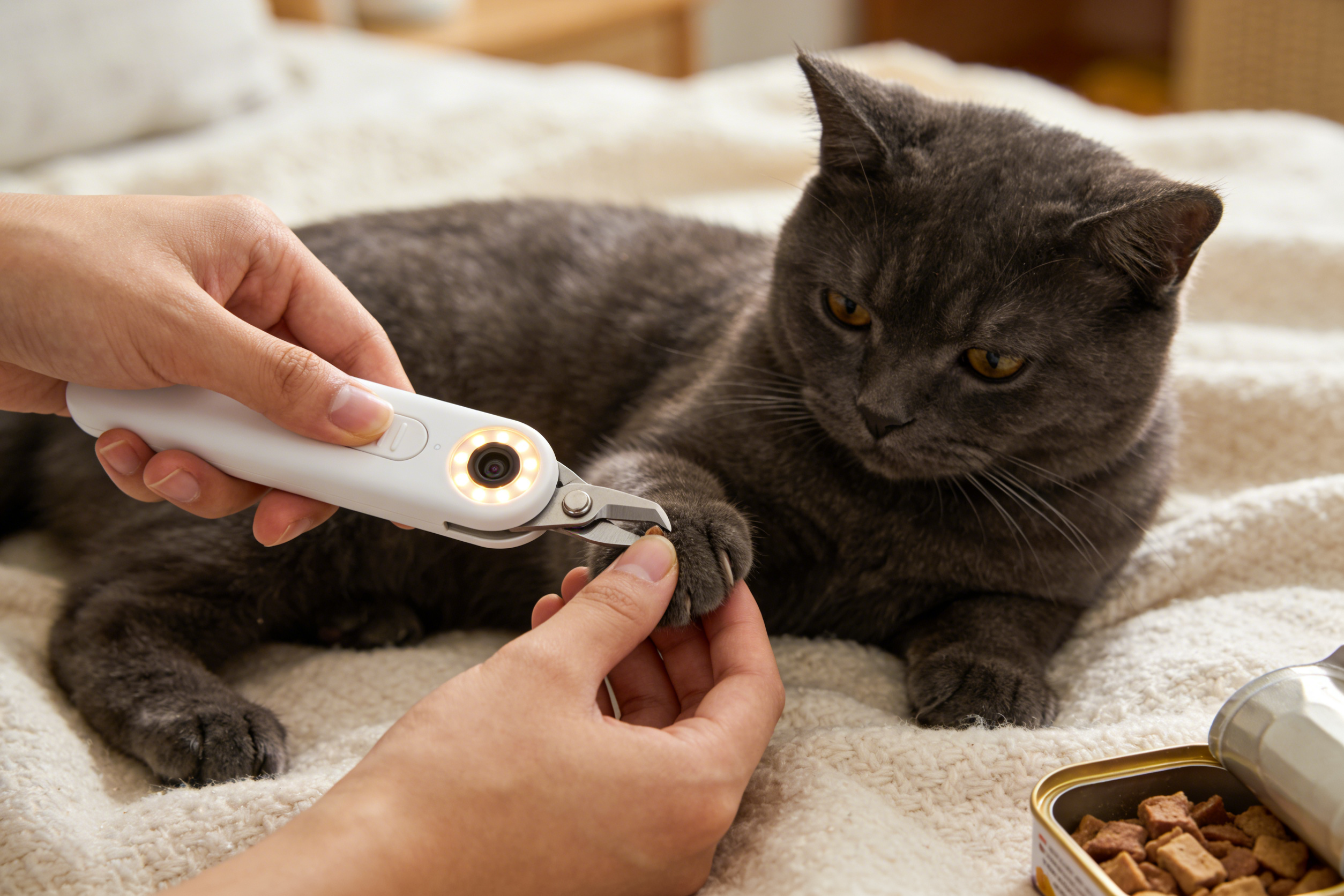
The most commercially successful response to this fear has been the safety guard. A metal plate that mechanically limits how deep the blade can reach, the safety guard transforms the product from a potentially dangerous instrument into a confidence-building tool for beginners. The gonicc clipper’s dominance on Amazon is directly attributable to this feature; it solves the emotional problem, not just the functional one. For the millions of owners who would otherwise pay for professional grooming, the $10 price point for a safety-guarded clipper is an easy purchase decision.
Beyond safety guards, the category is seeing premiumization through ergonomic design and material upgrades. Rubber-coated non-slip handles reduce hand fatigue during multi-pet sessions. Semi-circular blade designs that match the natural contour of the nail reduce slippage and improve cut predictability. Stainless steel blades with precision grinding deliver longer service life. These improvements command higher price points without fundamentally altering the product’s cost structure.
Price ladder analysis reveals a category well-segmented across value tiers. Ultra-value clippers retail between $3 and $7, mass-market core products between $8 and $15, premium feature-enhanced models between $16 and $25, and professional or vet-endorsed options between $26 and $40. The premium segment is expected to capture an increasing share of both unit sales and retail value, reflecting the willingness of pet owners to pay for features that reduce anxiety and improve outcomes.
The Cross-Border Seller‘s Perspective
For entrepreneurs and cross-border sellers, the pet nail clipper category offers a rare combination: a product with genuine demand, manageable logistics, and a reasonably level competitive playing field.
The product’s small size and light weight make it ideal for e-commerce fulfillment. A clipper weighs ounces, not pounds. It does not require special handling, refrigeration, or complex packaging. Shipping costs are low, and returns are manageable. In a world where logistics costs can destroy margins on bulky products, the nail clipper’s physical characteristics are a structural advantage.
Sourcing is straightforward. Chinese manufacturers have deep expertise in stainless steel blade production and precision grinding, and the supply chain is mature and competitive. The barrier to entry for a seller with a modest budget is low. The challenge, as always, lies in differentiation.
Amazon sales data reveals a category with substantial volume but fragmented leadership. The gonicc professional clipper has achieved over 42,000 ratings and consistent monthly sales. The Candure model, positioned as a professional grooming tool for all breed sizes, has generated approximately 10,000 units per month. Cat-specific clippers from Pet Republique and other brands have carved out loyal followings with products priced between $6.99 and $11.99. The presence of multiple successful products at different price points and targeting different pet segments suggests a market that rewards thoughtful positioning rather than pure price competition.
The emerging bearded dragon and small animal segment—clippers designed for reptiles, hamsters, rabbits, and birds—represents a particularly interesting niche. A leading bearded dragon nail clipper has achieved 30,000 monthly units at a $39.95 price point, demonstrating that even within the nail clipper category, species-specific specialization can command premium pricing.
Challenges and Considerations
No investment thesis is without risk. The pet nail clipper category faces several headwinds that merit attention.
The most significant challenge is the competitive intensity of core keywords. Search terms like “dog nail clippers” and “cat nail clippers” are among the most contested in the pet products category. Advertising costs for these terms are elevated, which erodes margins for sellers reliant on paid acquisition. A seller entering this category must either accept lower margins, develop alternative traffic sources, or differentiate sufficiently to compete on organic search.
There is also the risk of commoditization. A nail clipper is, at its core, a sharp blade attached to a handle. The patent landscape is limited, and design innovations are quickly replicated. The gonicc safety guard, for all its commercial success, is not protectable in any meaningful way. Competitors can and do offer similar features at similar price points.
Finally, the category faces the ongoing threat of substitution from electric nail grinders. While manual clippers remain the dominant format, particularly in value-oriented segments, grinders offer an alternative that eliminates the sharp-blade anxiety entirely. For pet owners willing to pay more, the grinder represents a superior experience. The penetration of grinders into the nail care routine is a long-term trend worth monitoring.
The Outlook: Stability with Upside
The pet nail clipper category is not a high-growth, venture-backed disruptor. It is something arguably more valuable to a certain type of investor: a stable, predictable, cash-generative segment of a growing market. The product solves a real problem. The demand is non-discretionary. The supply chain is mature. The logistics are favorable.
As the global pet grooming tools market expands toward $3.4 billion by 2032, nail clippers will remain a foundational category—unexciting, unglamorous, and quietly profitable. For sellers and investors with the patience to compete on quality, safety features, and positioning rather than on price alone, this unassuming tool offers a durable path to returns. The cash cow is not the most glamorous animal on the farm, but it may be the most reliable.