Beyond Blades: What the Cold Plasma Pet Brush Reveals About the Next Generation of Pet Nail Clippers
The cold plasma brush developed by the Analytical Instruments team at Zhejiang University’s Huzhou Institute has become an unlikely export success. Priced at roughly ten times the cost of a conventional pet brush, it raised nearly $30,000 against a $3,000 Kickstarter target, began mass production in February, and reached North American consumers by March . The technology is genuinely novel: plasma, often called the fourth state of matter after solid, liquid, and gas, is generated when gas molecules are ionized. The “cold” variant used here operates at temperatures low enough to avoid burning living tissue, while its reactive particles destroy bacterial cell membranes and break down odor molecules at the source rather than masking them .
But the brush is merely the first application. The team has already signaled plans to extend cold plasma into deodorizing devices, antibacterial litter boxes, and clean water fountains . The question worth asking is why the pet nail clipper—a product category with far higher stakes for both pets and owners—has been left out of this wave of material-science-driven reinvention.
The Nail Clipper’s Stagnation Problem
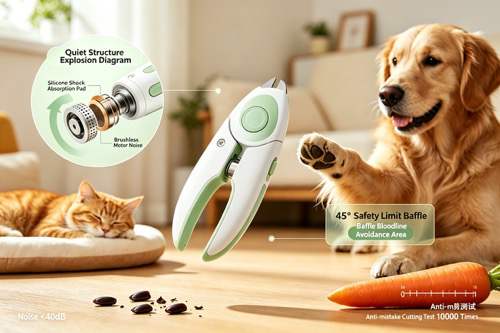
Walk through any pet retailer’s grooming aisle and the pet nail clipper offerings tell a story of incrementalism. Stainless steel blades, ergonomic grips, safety guards, and the occasional LED light attachment constitute the bulk of “innovation” in the category . The premium segment, priced between $16 and $25, is growing, driven by pet safety concerns and the rising cost of professional grooming, but the fundamental mechanism—a metal blade crushing or slicing through keratin—has not changed in generations .
This matters because nail trimming is among the most stressful routine procedures for both pets and their humans. A misaligned cut causes pain and bleeding. The sound and sensation of the clipper can trigger fear responses that compound over time. And unlike brushing, which the cold plasma device has made gentler and chemically free, nail trimming remains a purely mechanical, inherently risky interaction.
The cold plasma brush succeeded because it addressed a pain point the industry had accepted as unavoidable: odor and bacteria managed through shampoos and sprays that irritate skin and lose efficacy within days . The team’s insight was that a physical technology—ionized gas—could replace a chemical one. The same logic applies to clippers, but the target is not odor. It is the trauma of the cut itself.
What Plasma Might Offer a Clipper
The most immediate possibility is hemostasis and disinfection at the point of contact. Cold plasma has demonstrated antimicrobial effects in medical and veterinary contexts, and its reactive species can promote clot formation and tissue repair . A clipper incorporating a small cold plasma emitter near the blade—activated immediately after the cut—could sterilize the nail bed and accelerate clotting in the event of a quick. For pets with dark nails, where the quick is invisible and the risk of over-cutting is highest, this would represent a meaningful safety improvement rather than a cosmetic one.
A second avenue is sensory. The cold plasma brush produces no heat and leaves no chemical residue . A clipper designed around plasma-assisted cutting rather than mechanical crushing might reduce the pressure and vibration that many pets find aversive. The technology does not eliminate the need for precision, but it could make the experience less tactilely alarming.
The Strategic Logic for an Integrated Grooming Ecosystem
The Zhejiang team’s roadmap—brush, deodorizer, litter box, water fountain—reveals an ambition to build a suite of chemical-free pet care devices around a proprietary cold plasma platform. A clipper fits naturally into that ecosystem, not as a standalone gadget but as the missing piece in a complete at-home grooming routine. The brush handles coat and odor. The clipper would handle the most anxiety-inducing procedure. Together, they would address the two reasons most owners still pay for professional grooming despite the cost: the mess of bathing and the fear of cutting.
The brush’s North American reception also offers a template. The team validated the concept through crowdfunding before committing to mass production, and the premium pricing—ten times a standard brush—was accepted because the value proposition was legible: no chemicals, no residue, no irritation . A plasma-enabled clipper with a demonstrable safety benefit for dark-nailed pets would likely find a similar premium niche, particularly among owners who have experienced a bleeding quick and dread the next trim.
The Larger Point
The cold plasma brush is not important because it is a brush. It is important because it demonstrates that a laboratory-grade physical technology can be miniaturized, made battery-powered, priced at a consumer premium, and shipped to Amazon within months of a crowdfunding campaign. The barrier between “advanced research” and “something you buy for your dog” is thinner than the pet industry has assumed.
Nail clippers have been overlooked because they are unglamorous and because the mechanical approach “works” in the narrow sense that it eventually cuts the nail. But the same was true of odor management before the brush arrived. The pet care market has shown that it will pay for a genuinely better solution to an old problem. The clipper is the next old problem worth solving, and the technology to solve it is already sitting in a laboratory in Huzhou, waiting to be pointed at a different blade.